
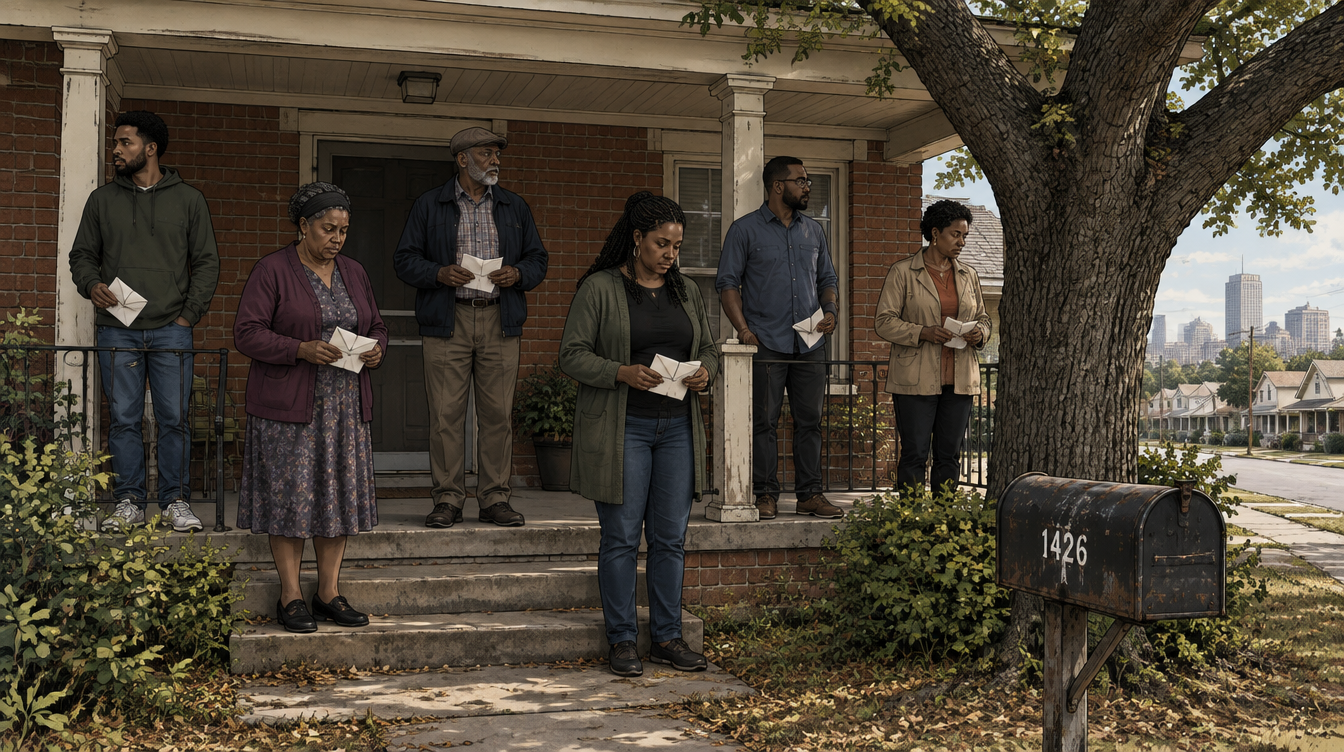
Thousands of Birmingham-area families own a house nobody can actually sell. The deed still says Grandma. She died without a will, the estate never went through probate, and now her children and grandchildren all own a slice of it together. Alabama law calls this heirs’ property, and according to the Alabama Cooperative Extension System, it comes with a dangerous feature most families discover too late: any single co-owner can go to court and force a partition, no matter how small their share and no matter what the rest of the family wants.
With Alabama’s title-fraud law in force since October 1, passed precisely because vacant and inherited houses have become prime targets, this is the season to get your family’s title untangled. Here is how heirs’ property actually works, the protections Alabama law gives you, and the mistakes that cost families their homes.
How a Family Loses the House
When an Alabama landowner dies without a will, the real estate passes to their heirs as tenants-in-common. Every heir owns an undivided fractional interest, and each generation slices the fractions thinner. Auburn University’s Extension specialists describe the classic trap: a real estate speculator buys one relative’s small share, often from a distant heir who has never paid a dollar of taxes on the place, then files a partition lawsuit to force the sale of the entire property.
Alabama Extension outlines the two forms a partition can take. Partition in kind physically divides the land, which rarely works for a city lot with one house on it. Partition by sale sells the whole property and splits the proceeds. Historically that meant an auction on the courthouse steps, where, as Extension puts it, homes sold to the highest bidder at a fraction of market value, and heirs were rarely able to outbid the speculators who engineered the sale in the first place.
The co-owner who files does not need anyone’s permission. If a relative cannot be located, the court appoints a guardian ad litem and the case moves forward anyway. Court fees, sale costs, and attorney fees all come out before the family sees a dime.
The Protections Alabama Law Gives You
Alabama adopted the Uniform Partition of Heirs Property Act (Ala. Code § 35-6A), effective in 2015, to blunt the worst of this. Per Alabama Extension, when a partition action involves heirs’ property, the law requires:
- Enhanced notice. Every known heir gets notified, and a sign goes up on the property itself.
- An independent appraisal. A disinterested licensed appraiser sets the fair market value, so the sale price is not whatever a courthouse-steps bidder feels like paying.
- A right of first refusal. The other co-owners get the chance to buy out the person forcing the sale before the property goes anywhere.
- A preference for dividing rather than selling, where division is practical.
- An open-market sale at a court-determined value if the property must be sold, instead of a fire-sale auction.
These are real protections, but Extension is blunt about the limits: the UPHPA can still end with the property sold outside the family. In their published case study, an heir named Sara had the right to buy out the cousin who sued for partition, could not raise the money in time, and lost the home she had lived in her whole life. The law got her a fair price. It did not save the house.
What Birmingham Families Should Do Instead
The lesson is not that selling is bad. It is that a forced, court-supervised sale is the worst way to do it. A family that gets ahead of the problem has far better options:
- Map the ownership now. Figure out every living heir and their fractional share before a speculator does it for you. A probate attorney or a title company can pull the chain of title.
- Never let a relative sell a fractional share to a stranger. That single transaction is how partition suits start. If an heir needs cash out, the family buying that share keeps control.
- If the family agrees to sell, sell the whole property together, voluntarily. With every heir signing, you can sell on your terms, on your timeline, and skip the court costs, guardian ad litem fees, and attorney percentages that a partition action subtracts from everyone’s share.
That third path is where a direct cash sale shines. An inherited Birmingham house that has sat vacant for years usually needs repairs no one wants to fund and no traditional buyer wants to finance. Birmingham Homebuyers buys inherited houses as-is, for cash, and a sale with multiple heirs works the same way as any other: every heir signs, and every heir is paid their share at closing. Get a cash offer today and put a real number in front of the family. Sometimes one honest number is what finally gets six co-owners to agree.
One more reason not to leave an inherited house sitting in limbo: Alabama’s Property Protection Act took effect October 1, 2026, because vacant and inherited homes are the top targets for deed and title fraud. We covered what the new title-fraud law means for Birmingham owners in detail. And if the estate does need to go through probate first, start with our guide to probate before selling a house in Alabama.
Birmingham Homebuyers is a local, A+ BBB-rated cash home buyer with 75+ five-star reviews from Birmingham-area sellers.
Sources
- Alabama Cooperative Extension System (Auburn University / Alabama A&M), “Partition Actions,” HE-0852, peer-reviewed, revised Sept 2024: https://www.aces.edu/blog/topics/home/partition-actions/
- Ala. Code § 35-6A (Alabama Uniform Partition of Heirs Property Act), effective 2015