
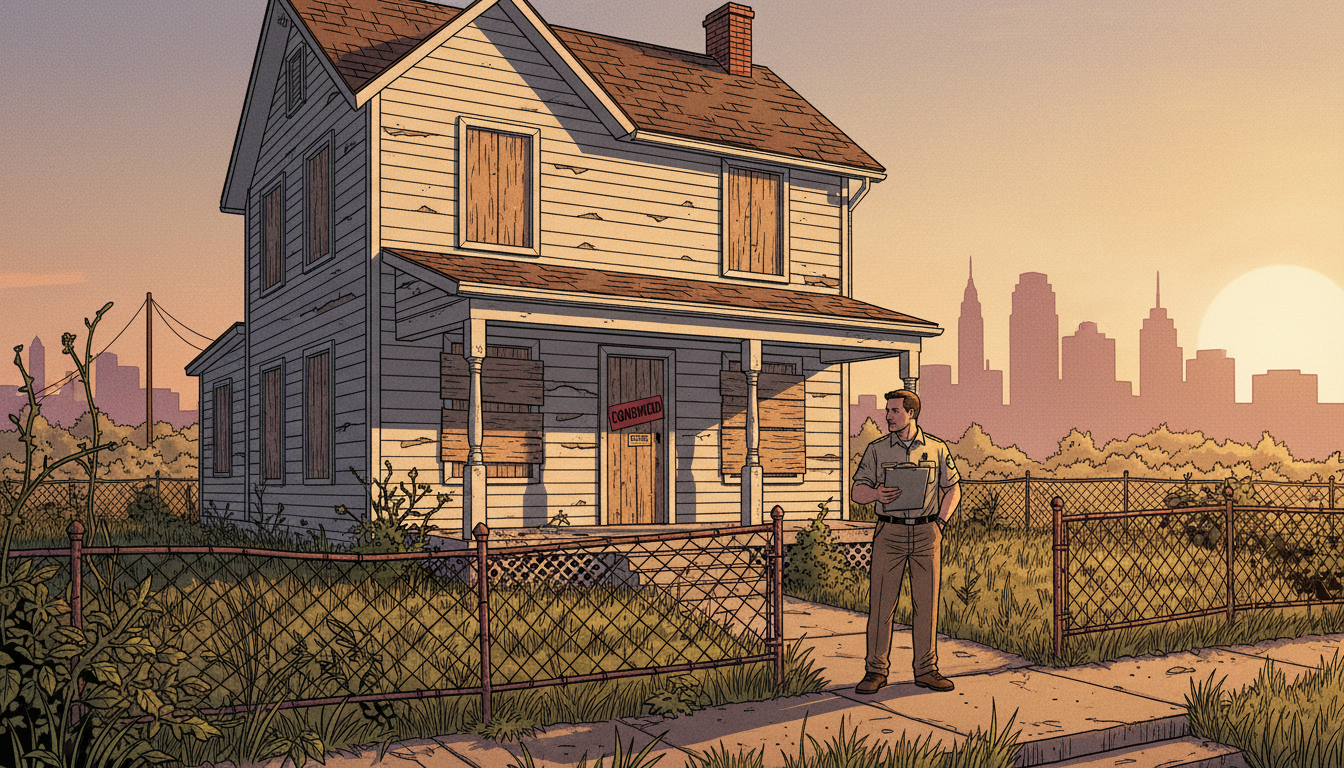
Starting October 1, an empty house in Birmingham stops being free to own.
A new state law passed in the 2026 regular session gives Birmingham the authority to create a vacant property registry, and WBRC reported that it will require owners of buildings sitting empty more than three months to register them, maintain them, and pay a fee. WBRC reported the registration fee at $250, escalating 150 percent per year and capping at $1,000.
The enforcement teeth are the part owners should read twice. According to WBRC, the law will be enforced through inspections without notice and fines, and any unpaid fine can become a lien on the property.
“Fix them up, renew them, refresh them, remodel them or sell them,” Rep. Patrick Sellers, who represents District 57, told WBRC. “Do something with them so it doesn’t hinder the communities of Birmingham.”
That is about as direct a statement of legislative intent as you will find. The point of the fee is not revenue. The point is to make sitting on an empty house more expensive than doing something with it.
Where this came from
The registry is one piece of a four-bill package the city pushed in Montgomery this year. The Alabama Association of REALTORS 2026 legislative recap describes HB315, sponsored by Rep. Mary Moore of Birmingham, as legislation allowing Class 1 municipalities to enact a vacant land registry, require fees for vacant land, and adopt enforcement provisions.
Class 1 is the key word. Under Alabama’s municipal classification, a city has to exceed 300,000 residents to qualify, and Birmingham is the only city in the state that does. This law applies inside Birmingham city limits and nowhere else.
REALTORS opposed the bill as originally filed, saying it contained provisions that made it easier for local government to seize private property, then worked on amendments and ultimately aided its passage. The association’s recap notes it “supports efforts to reduce blight and vacant/abandoned properties.”
The city framed it in terms of who pays. “Our goal is to address blight more efficiently, protect neighborhood quality of life, and reduce the burden on taxpayers by shifting costs back to responsible parties,” Birmingham said in a statement to WBRC. The city added that it was still reviewing the final version of the bill.
What is still unsettled
Two things are worth being honest about.
First, the fee structure as reported does not resolve cleanly. A $250 fee escalating 150 percent per year would pass $1,000 in the third year, so the cap does real work, but where exactly each year lands is a detail the city ordinance will have to spell out. The state law is enabling legislation. Birmingham still has to pass the ordinance that implements it.
Second, the city said in April it was reviewing the final bill and evaluating how it fits existing blight reduction efforts. Registration mechanics, the definition of vacant, exemptions, and the appeals process are all things the ordinance will define. If you own property that might qualify, the ordinance is the document to watch between now and October.
What is not in doubt is the direction. Veronica Edwards-Johnson, president of the Powderly neighborhood association, told WBRC about a house near her that has been empty for a quarter century. “This property I’m pretty sure has been empty probably 25 years or more,” she said. “There’s one there, and one across the street and one up the street that’s empty.” Neighborhoods have been asking for this for a long time.
Who this actually hits
Not slumlords, mostly. The people who get caught by vacant property registries tend to be ordinary owners who ended up with a house they did not plan for:
- An heir who inherited a house in Ensley, East Lake, or Woodlawn and has been paying the property taxes while the estate sorted itself out.
- An owner who moved for work, could not sell at the price they wanted, and left it empty rather than take less.
- A landlord who lost a tenant, priced out the repairs the next tenant would require, and closed it up “for now.”
- A family that boarded up a house after a fire or a burst pipe and never got the insurance money to stretch far enough.
For all four, the math after October 1 changes in the same direction. Add an annual registration fee that escalates, plus inspections without notice, plus fines that can lien the property, on top of taxes, insurance, and whatever the house is already costing to secure. A house that was quietly break-even to hold becomes a house that bleeds.
One more consideration: unpaid fines that become liens are a title problem, and title problems are what turn a simple sale into a six-month sale. The cheapest time to deal with a vacant house is before the liens attach.
If you own one, the clock starts October 1
The law takes effect October 1, 2026. That leaves a real window to decide.
Fixing it up and renting it is a good answer if you have the capital and the appetite. Listing it is a good answer if the house shows well and you can carry it through a marketing period. Neither one is realistic for a house that needs a roof, has been vacant three years, and sits in a neighborhood where the comps do not support a rehab budget.
That last category is what Birmingham Homebuyers exists for. We buy vacant and inherited houses in any condition, as-is, for cash. No listing, no agent commission, no repairs, no cleanout. You do not have to fix the roof or haul off what is in the basement.
If you want to know what your empty house is worth before the registry starts, you can get a cash offer today. It costs nothing and it is not an obligation.
Related reading: selling a house as-is for cash in Birmingham, selling an inherited house fast, and our page on selling your house in Birmingham, AL. If your property sits outside Birmingham city limits, the registry does not reach it, but we still buy in Bessemer, Irondale, and Trussville.
This article summarizes news reporting on a new Alabama law. Birmingham’s implementing ordinance had not been finalized as of publication. This is not legal advice.
Sources
- Gillian Brooks, “New Alabama law targets Birmingham’s vacant properties with registry, fees,” WBRC, April 9, 2026 — https://www.wbrc.com/2026/04/09/new-alabama-law-targets-birminghams-vacant-properties-with-registry-fees/
- The Birmingham Times republication of the same WBRC report, April 9, 2026 — https://www.birminghamtimes.com/2026/04/new-alabama-law-targets-birminghams-vacant-properties-with-registry-fees/
- Alabama Association of REALTORS, “2026 Legislative Session Recap,” April 21, 2026 (HB315, Class 1 municipalities, vacant land registry) — https://www.alabamarealtors.com/posts/2026/04/21/2026-legislative-session-recap