
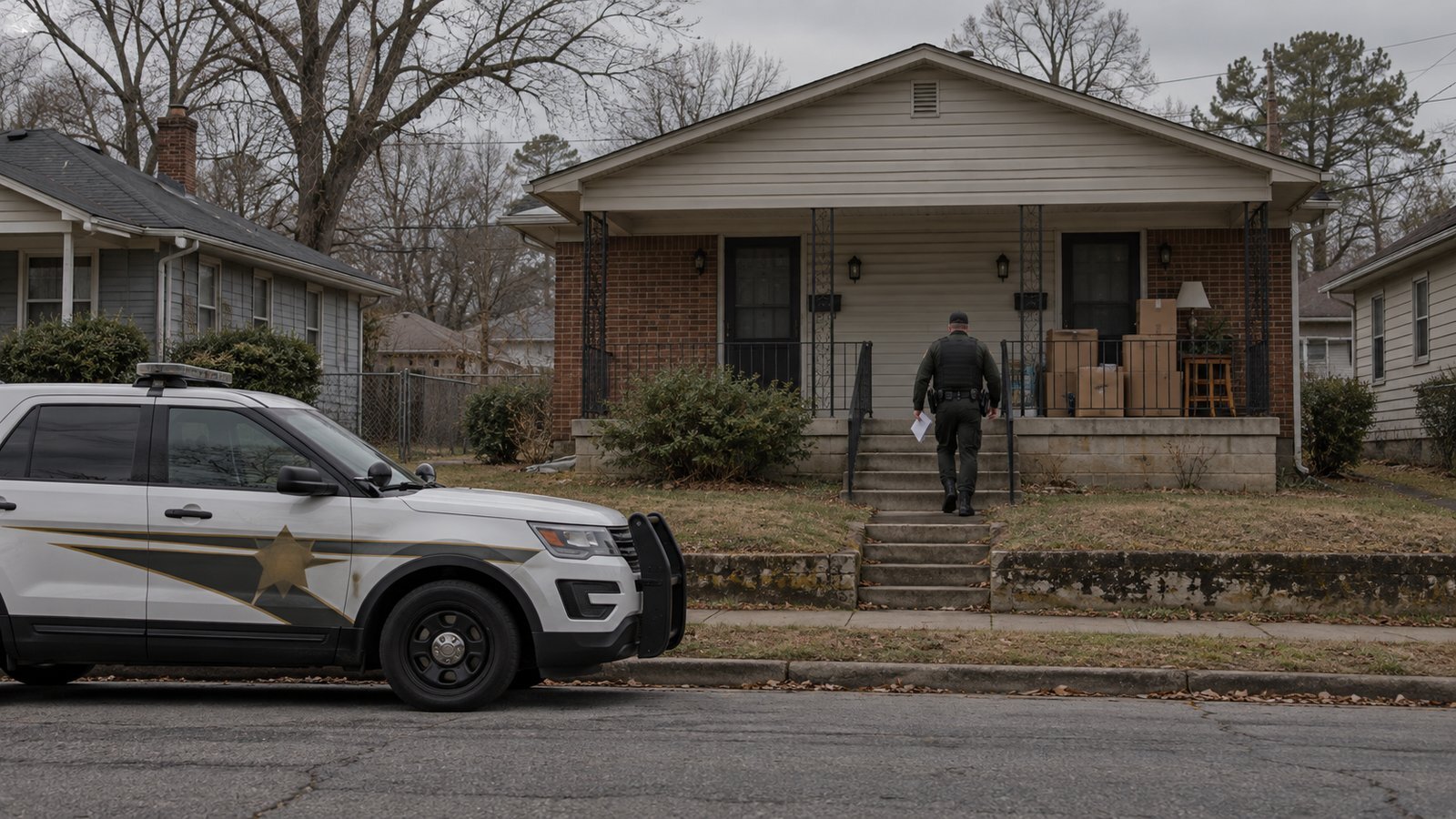
A new Jefferson County law carries an Oct. 1, 2026 effective date that lets the sheriff bring in outside, certified officers to execute writs on real property when the backlog gets too deep. HB234, sponsored by Rep. Allen Treadaway (R-Morris), passed the Alabama Senate 30-0 on Feb. 10 and went to Gov. Kay Ivey, according to the Alabama Reflector’s roundup of that week’s votes. The Alabama Association of REALTORS reported it as law in its April session recap, listing it among the landlord-tenant measures and describing it as a program to address “a backlog of unexecuted writs.”
If you own a rental in Birmingham, Bessemer, Gardendale, Hueytown or anywhere else in Jefferson County and you have ever won an eviction judgment and then waited weeks or months for the sheriff to actually put you back in your house, this law is aimed at you. It is also narrower than the headline suggests.
What the backlog looks like
The problem is not new. In May 2024, ABC 33/40’s I-Team reported that evictions in Jefferson County were backlogged as the sheriff’s office tried to catch up after the pandemic. One property owner told the station she had not received a good rent payment since the prior June and was owed $10,000 while still paying the mortgage, insurance, taxes and attorney fees. Others said that even with a court order they had waited months, and in some cases up to a year, to get their property back. Neither the civil court nor the sheriff’s office could provide official numbers, but homeowners said they had been told 150 to 200 eviction orders were still not completed. The station reported the sheriff’s office was short 50 deputies, and a spokesperson said it could not shift more personnel to eviction work.
The sheriff’s own Court Services page puts the scale in context: the division serves roughly 250,000 civil processes and more than 20,000 arrest warrants a year, and it says plainly that executing evictions “does take time.”
The Alabama eviction process, called an unlawful detainer, has several steps before the sheriff is even involved. As ABC 33/40 laid it out, with commentary from Chisolm Allenlundy, chair of Legal Services Alabama’s housing practice group in Birmingham, it starts with a valid lease termination notice, then a filing in civil court, then a seven-day window for the tenant to respond, then a trial where a judge decides whether to issue a writ of possession. Only after all of that does the landlord wait for the sheriff to set a date. That last wait is the part HB234 addresses.
What HB234 actually does
The enrolled act is short. Here is what it says, in plain terms.
It only turns on when the sheriff says so. The law defines an “emergency writ condition” as any time, “as determined by the sheriff,” when more writs have been issued in the county than the sheriff can execute in a reasonable time. The sheriff decides whether that condition exists. Nothing in the act forces a declaration, sets a numeric trigger, or lets a landlord demand one.
It never says “eviction.” The act covers any writ from the Tenth Judicial Circuit’s clerks “relating to the seizure or securing of real property located within Jefferson County,” which is where a writ of possession from an unlawful detainer falls. The eviction framing comes from the Alabama Association of REALTORS, which filed the bill under landlord-tenant legislation and tied it to the writ backlog.
Special reserve deputies are outsiders, not new hires. During an emergency writ condition, the sheriff may appoint special reserve deputies to help execute writs “involving the seizure or securing of real property.” To qualify, a person must be currently certified by the Alabama Peace Officers’ Standards and Training Commission, must not be employed by the sheriff’s department at the time of appointment, and must have completed the sheriff’s writ-execution training within the last three years. The sheriff has to build that training program and keep records of who completed it.
The landlord pays, and the cap is $250. If an emergency writ condition exists, a petitioner (in practice, the landlord holding the writ) may request that the writ be executed by a special reserve deputy. Once the deputy executes it and returns it to the clerk, the petitioner pays a service fee that “may not exceed two hundred fifty dollars ($250),” paid directly to the deputy. The deputy cannot be paid from the county treasury for serving writs, and the sheriff cannot collect any fee for a writ a special reserve deputy serves.
Same legal protections as a regular deputy. A special reserve deputy acting within the scope of the act gets the same immunities as deputies under Section 36-22-3 of the Code of Alabama.
Effective date: Oct. 1, 2026. The act applies to writs issued by the Circuit or District Clerk of the Tenth Judicial Circuit, which is Jefferson County, and nowhere else.
What it does not do
This is where a landlord’s expectations need to be realistic.
It does not shorten the court side of the process. The notice, the filing, the seven-day answer window and the trial are untouched. If the district court calendar is the bottleneck (Allenlundy told ABC 33/40 in 2024 that “there are only four district court judges”), HB234 does nothing about that.
It does not guarantee a faster writ. The sheriff has to declare an emergency writ condition first, and the county has to have trained and appointed reserve deputies ready to go. Neither the sheriff’s office News page nor its Court Services page mentioned the program as of Sept. 21, and the law only took effect Oct. 1. Whether it becomes a working program or a dormant one depends on decisions the act leaves entirely to the sheriff.
It does not recover the rent you already lost. Every month a nonpaying tenant stays is a month of mortgage, taxes, insurance and often utilities you are covering out of pocket. The ABC 33/40 owner who was out $10,000 would still be out $10,000 the day the deputy arrived.
The math a tired Birmingham landlord should actually run
Say you own a $150,000 rental in Bessemer or Gardendale with a tenant who stopped paying in March. You filed, you won, and you are in the writ queue. Under HB234 you might, if the sheriff declares a backlog and has deputies trained, pay $250 to move faster. Then you get back a house that has had an angry occupant in it for six months. Now you are looking at turnover repairs, a vacancy period, re-leasing costs and the next tenant’s risk, and you are doing it in a market where, as we covered in our post on Alabama’s rising foreclosure numbers, ATTOM’s CEO said financial pressure “may be building for some homeowners.”
For some owners the right answer is to stay in the game, use every tool including this one, and re-rent. For others, the backlog was simply the last straw. If you are in the second group, there is a path that skips the queue entirely.
Selling a Jefferson County rental with a tenant still in it
Birmingham Homebuyers buys occupied rental houses across Jefferson County, including houses where the tenant is behind, where the eviction is pending, or where you have a writ and are still waiting on the sheriff. We have been doing this for 30+ years and have 75+ five-star reviews from sellers, many of them landlords who were done.
Here is what that looks like in practice. You request a cash offer on the house as it sits. We price it with the occupancy and the condition already factored in, so there is no surprise at closing and no repair list. We close on your timeline, often in days, and the tenant situation becomes ours to resolve, not yours. No commissions, no showings with a hostile occupant, no waiting for a retail buyer’s lender to decide whether an occupied, behind-on-rent property is something it will finance.
If you have been chasing rent for months, our post on what to do when you’re tired of chasing rent in Birmingham walks through the options, and our guide to selling a rental property fast in Birmingham covers what an occupied sale looks like step by step. We buy throughout the county, including Bessemer, Gardendale, Hueytown and Pinson.
Bottom line
HB234 is a real, if modest, tool for Jefferson County landlords stuck at the last step of an eviction. It took effect Oct. 1, it costs up to $250 per writ, and it only works once the sheriff declares a backlog and has certified outside deputies trained and ready. Watch for an announcement from the sheriff’s office before you count on it. And if the months of unpaid rent have already made the decision for you, Birmingham Homebuyers will buy the house with the tenant in it and take the problem off your hands.
Sources
- Alabama Legislature, HB234 (2026 Regular Session), enrolled act: https://alison.legislature.state.al.us/files/pdf/SearchableInstruments/2026RS/HB234-enr.pdf
- Alabama Reflector, “What passed in the Alabama Legislature: Feb. 10-12, 2026”: https://alabamareflector.com/2026/02/13/what-passed-in-the-alabama-legislature-feb-10-12-2026/
- Alabama Association of REALTORS, “2026 Legislative Session Recap” (April 21, 2026): https://www.alabamarealtors.com/posts/2026/04/21/2026-legislative-session-recap
- ABC 33/40, “Eviction backlog costing property owners thousands of dollars in lost rent payments” (May 6, 2024): https://abc3340.com/news/local/eviction-backlog-costing-property-owners-thousands-of-dollars-in-lost-rent-payments-squatter-economy-jefferson-county
- Jefferson County Sheriff’s Office, Court Services Division: https://jeffcosheriffal.com/court-services/